Why a Boundary Looks Different Beside the Sea
Coastal sports boundary visibility can be tricky against bright water. Use fixed landmarks and a simple routine to follow the playing edge more clearly.
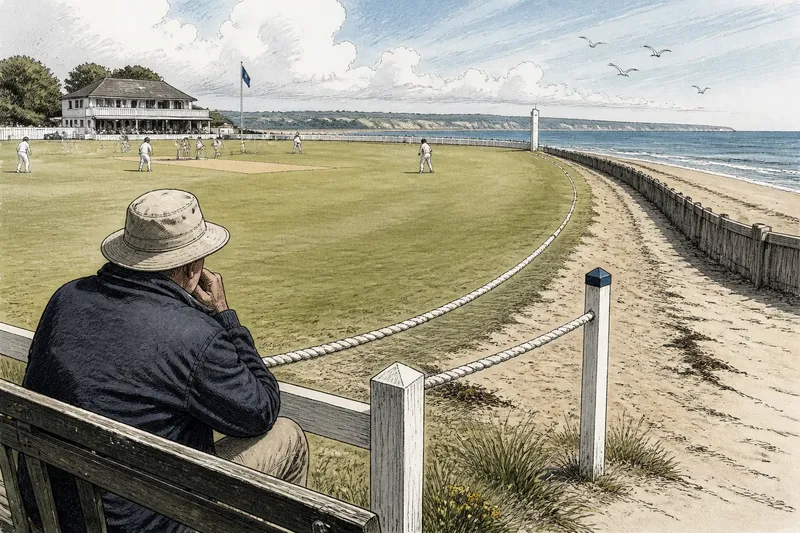
The common mistake at a coastal ground is to treat the sea as a helpful backdrop; it can hide the edge you are trying to follow. Coastal sports boundary visibility becomes difficult when a rope or painted mark blends into pale water, wet sand or bright sky. Fixed landmarks help you track the line without mistaking the horizon for the playing boundary.
Why coastal sports boundary visibility changes beside the sea
A boundary is marked on the ground, but spectators see it through contrast, distance and whatever lies behind it. Inland, a fence, stand or dark tree line may provide a steady reference. Beside the sea, the background can be broad and nearly uniform, making a rope or painted mark seem to fade.
The horizon adds another complication. It is a strong visual line, but it is not the sporting boundary. When the two run in similar directions, your gaze can slide from the playing edge to the distant water. Glare and passing cloud can also change how clearly the boundary stands out.
This is not a question of learning a different rule. Choose useful references on the ground, then check how they line up from your seat or standing place.
Build a small landmark map before play
Look for objects that are easy to distinguish and unlikely to move. A corner post, the end of a low barrier, a permanent pavilion edge or a distinctive gap in a fence can help. Avoid using people, parked vehicles, loose equipment or waves as references; they change too often to anchor your view.
Choose two or three points along the edge. Notice where the boundary meets a fixed feature at each end, then look for a third reference near the middle if one is available. The alignment matters more than the object’s name: note what sits behind the line and how it runs between the points.
If the venue has a ground plan or a sign showing the playing area, compare it with the view. Use it for orientation, not as a substitute for the visible boundary. It may help you distinguish the sea-facing edge from an access path or a separate practice space.
Use a matchday routine that adapts to the view
Use this routine before play, then return to it if glare, movement or activity near the edge makes the line hard to follow.
- Before play: Identify the nearest clear boundary marker and the fixed feature behind it. If they identify the playing edge, use them as your first reference; if they point towards a path or shoreline, check the venue plan or ask staff instead.
- At the first pause: Trace the line from one landmark to the next. If a rope, paint mark, low kerb or surface change connects them, follow that feature; if the line breaks from view, look for another fixed marker.
- When the light shifts: Check a darker or more textured reference, such as a post or barrier. If the edge remains hard to separate from glare, change to a permitted viewing angle rather than guessing.
- After moving: Rebuild the landmark map from your new position. If the markers still separate clearly, use that view; if perspective makes them overlap, move to another permitted spot or rely on the official’s view.
- When play approaches an unclear section: Follow the nearest ground-level marker. If you cannot see enough to judge confidently, watch the official or ask venue staff rather than calling an outcome from a distant impression.
Say you arrive at an invented small coastal cricket ground where a pale rope runs beside bright sand. From your seat, the rope seems to vanish near a low fence. You identify the fence end and a corner post, then move to a permitted spot where both markers and more of the rope are visible. The result is a clearer view of where the playing edge continues; it does not change how the rules are applied.
Which viewing position helps you follow the boundary?
What if the boundary disappears against the water?
Stop using the horizon as a guide and look for a ground-level marker, such as a post, rope or surface change. If no continuous line is visible, move to a permitted spot where the landmarks separate more clearly.
How do you read the edge when the sun is low?
Shift your gaze away from the brightest reflection and use shaded or textured objects as anchors. If the line remains difficult to see head-on, try a permitted angle that separates it from the water.
Should you trust a view from the end of the ground?
An end-on view can compress distances and make separate markers appear to overlap. Use it to understand the direction of the edge, then check the alignment from a side position if spectators can access one.
What if the venue has no obvious fixed landmarks?
Look for several modest references, such as the meeting point of two surfaces or the end of a permanent barrier. If the boundary remains hard to distinguish, avoid making a confident call from your seat and rely on the match officials’ view.
Know when landmarks cannot settle a decision
Visual landmarks help you follow the shape of the playing space; they do not adjudicate close decisions. You may be too far away, at the wrong angle or looking across an obstructed section. The official boundary marking and the competition’s procedures determine play. A landmark map only helps you understand where to look.
Keep your bearings local. A feature that aligns with the edge from one stand can appear to sit inside it from the promenade. Wet sand may also resemble part of the field, but the tide line, a wave’s reach or a temporary object is not a reliable boundary marker.
At your next coastal match, identify two or three fixed references before play and return to them if conditions change. Coastal sports boundary visibility is easier to judge when you track the ground-level markers, not the sea’s horizon.